About Syria
Understanding Souqs in Syrian Historic Cities
Understand Syrian souqs through dated Aleppo and Damascus photographs, distinguish market passages from shops, and ask clearer neighbourhood questions.
In this article
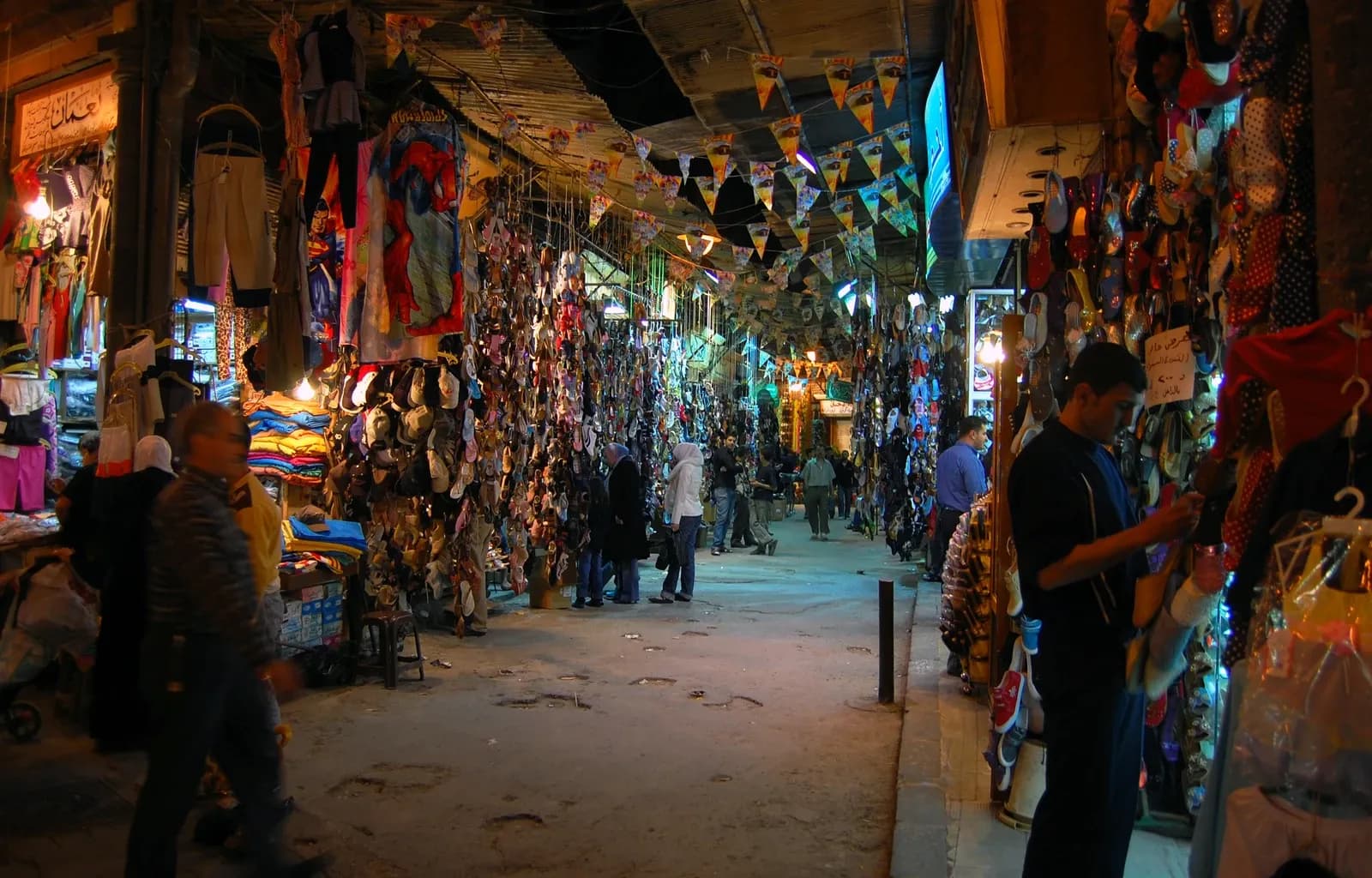

A souq is a market, but looking at it as a collection of shops misses much of what makes the setting interesting. In a historic Syrian city, the passage between stalls, the entrances along it and the connection to surrounding streets deserve as much attention as the merchandise. For someone researching a neighbourhood, the useful question is how a particular market relates to the places they would use. An attractive market photograph cannot answer that on its own.
This guide uses two dated photographs, one from Aleppo and one from Damascus, to separate the street, the shop and the wider historic setting. It offers a way to read those layers without pretending that archive images show current trading conditions, opening hours or a route that can be used today. Think of the photographs as starting points for better questions, rather than a recommendation to visit or buy nearby.
Begin with a named place, not a general impression
“Near the souq” is a description to clarify. Ask which market, which entrance and which surrounding street the speaker means. A neighbourhood name, a shop name and the name of a long passage can refer to different scales. If a property description relies on a familiar landmark, request a marked location and an explanation of the route from that landmark to the actual building entrance.
Spelling also matters when gathering evidence. Souq, suq and souk appear in English records, while place names can have several transliterations. Save the Arabic name alongside the English version when it is available. That makes it easier to compare a photograph caption, a map label and a written description without assuming that similar-looking names identify the same place. Keep the source of each name with it.
For the larger Aleppo setting, our guide to the Citadel of Aleppo explains why one prominent landmark needs to be read in relation to the surrounding city. A market passage deserves that same attention to its immediate context.
Read the passage before reading the shopfront
James Gordon's April 2008 photograph of a covered Aleppo souq gives the eye several things to follow: a central walking space, merchandise along both sides, shop openings and an overhead covering. The scene has depth. Nearer displays occupy the edges, while the passage continues beyond the people visible in the middle. Those are observations about this frame at this moment; they do not establish dimensions or the full length of the market.
Try describing the picture without adjectives such as “authentic” or “bustling.” Where is the walking space? What helps you distinguish one opening from the next? Which parts disappear into shadow or behind goods? This turns an atmospheric image into a spatial exercise. It also reveals what you cannot see, including side connections, other entrances and the condition of the roof above the camera.
UNESCO's Ancient City of Aleppo record treats suqs, khans and residential lanes as parts of a wider historic urban fabric. Its historical description is useful context, not a current directory of businesses. Resist attaching a city-wide heritage description to every wall or opening in an individual photograph. A specific building history needs specific evidence.
A shop interior answers a different question
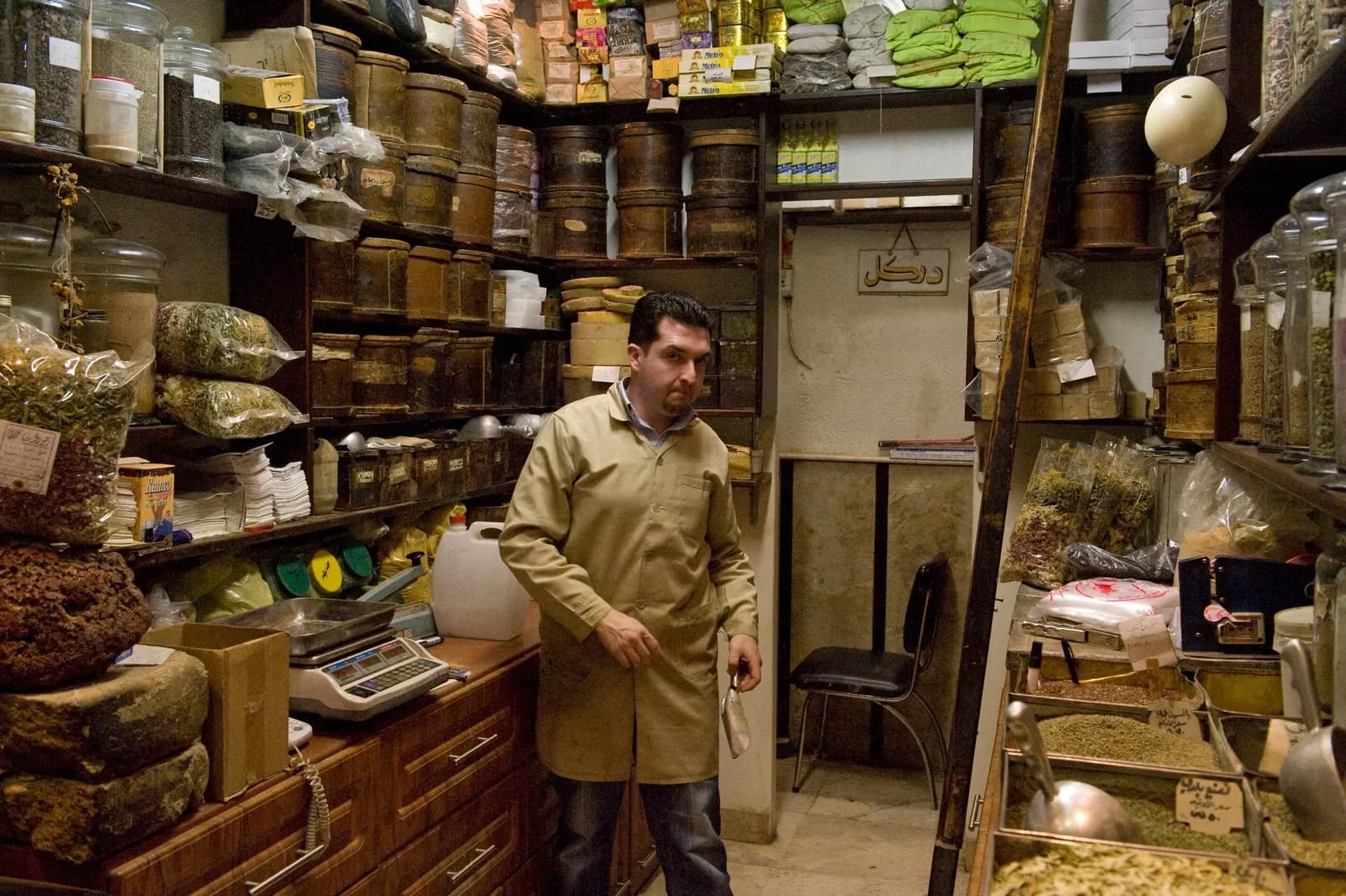
Dick Osseman's April 2009 photograph, identified in the source record with Damascus's Suq Midhat Paşa, looks into an individual shop. Shelves, containers, a counter and scales organise a much smaller space than the Aleppo passage. The shop and the street are connected, but a view of one cannot stand in for a survey of the other. The photographer's record does not identify the person pictured or establish the shop's present status.
This distinction helps when comparing images supplied with a neighbourhood description. A close view of a well-stocked interior may tell you very little about how to reach it. An exterior scene may show entrances without explaining what is available inside. Pair the images with their captions and dates before drawing conclusions. Do not infer product quality, prices, daily availability or a trader's recommendation from either frame.
The UNESCO record for Ancient City of Damascus describes a historical craft economy with areas associated with particular trades. That is a historical reference. It does not prove that a photographed shop carries the same products now, or that a market name describes every business along a present-day route.

Distinguish a commercial edge from a home entrance
If you are considering a home near a historic market, trace the route to the home rather than stopping at the landmark. Where does the described commercial frontage end? Where is the residential entrance? Does the information show the actual doorway, or only a street nearby? Record these as questions until someone can provide current, property-specific evidence.
The arrangement of a home also requires its own explanation. Our guide to traditional courtyard houses in Syria reads entrances and room connections through named architectural examples. Neither a courtyard example nor a souq photograph establishes the layout of a home being offered. Ask for the relevant plan and an explanation tied to that building.
Imagine two descriptions using the same market name. One points to a doorway on a commercial passage; the other points to a residential street reached through several turns. Even without estimating distance, you can see that the descriptions need different follow-up questions. The landmark is shared; the evidence about access is not yet complete.
Keep the archive date in view
Both photographs here predate later changes to the cities. They are evidence of the scenes photographed in 2008 and 2009, not proof of current access, occupancy or condition. If someone sends a similar image to support a present-day claim, ask for its capture date and the exact place it shows. An upload date alone may be years later than the photograph.
Build a small source note for each image: place, creator, capture date if known, source link and what the frame actually demonstrates. Leave an unknown as unknown. When two records disagree, preserve the disagreement while looking for clarification. A clear limit is more useful than a confident caption assembled from assumptions.
Turn curiosity into a usable neighbourhood brief
Finish your research with a short description of what you want to understand: the named market, its relationship to a residential address and the current evidence still needed. Our guide to researching neighbourhoods in Aleppo helps connect that enquiry to household priorities.
Keep cultural interest and practical requirements visible together. You may value a historic setting while still needing a clear explanation of an entrance, a household journey or the separation between shopfront and living space. Good research leaves you with a more precise question than “Is it near the souq?” It tells you which place you mean, why the relationship matters and what evidence would make the answer useful.
Continue your research
Reading the Difference Between a Historic Site and a Modern Neighbourhood
Distinguish heritage sites, building age and neighbourhood descriptions in Syria, using dated Damascus photographs and clear questions for an exact address.
Read more
Syria UNESCO World Heritage Sites: An Introduction
Explore Syria’s six UNESCO World Heritage entries, their inscription dates and scope, with real archive photographs and links to the official records.
Read moreSources & review
Last reviewed:
PUT YOUR RESEARCH TO WORK
Start with a place.
Explore Syria’s cities and narrow your property search.